3. PREPARATION OF THE COATING MATERIALS

All coating materials must be prepared prior to use. Prior to opening the product container or applying the coating material to parts, the temperature of the coating material must be acclimated to the ambient temperature. If the temperature of the coating material has not been acclimated to the ambient temperature, there is a risk that condensation could form which will contaminate the zinc flake coating with moisture and damage it. During transportation and storage, the soild particles in the coating material will settle on the bottom of the delivery container. As a result, it is necessary to mix the contents of the container until all of the solid components are thoroughly integrated into solution prior to application.

All coating materials must be prepared prior to use. Before using the material, it must be ensured that it has reached ambient temperature. Otherwise, there is a risk that condensation (moisture) could enter the coating. During transport and storage, the heavier particles settle at the bottom of the container. Therefore, the contents must be homogenized before further use.

The stirrer is adapted to the respective product. By default, a mixer with an impeller blade is used. The rotational speed should be low enough to avoid creating a vortex, which could draw air into the material, bringing a certain amount of moisture with it. To prevent electrostatic charging, all mixing containers must be grounded.
Mixer in action
Mixer with solvent-based basecoat
For solvent-based basecoats, the coating is stirred in the delivery container using a dissolver disc. The coating should be mixed for approximately 10–20 minutes until fully homogenized. Proper mixing can be checked with a clean rod; no residues should adhere when stirring the contents. For safety reasons, solvent emissions must be ventilated from the indoor air.
Automatic mixer
In addition to this standard method, there is another method in which mixing takes place automatically with the lid closed. This prevents solvent escape and moisture ingress. This requires a gyroscopic mixer that rotates the container simultaneously around two axes. This process also takes less time, but it is only suitable for full containers and a subset of products.
Standard mixing method

Coatings in the application process must be kept homogeneous. To prevent the solids from settling or separation, it is necessary to slowly stir the coating from time to time. It is recommended to stir for 10 minutes every hour at very low speed (10–20 rpm). Fast stirring must be avoided as it may damage the material.

The coating experiences a certain amount of movement during application, which contributes to its homogeneity. This works particularly well with a high throughput throughout the process. However, this movement alone is insufficient to maintain long-term homogeneity.

Conversely, it is essential to avoid large amounts of mechanical energy acting on the coating. When using a stirrer, a low speed (10–20 rpm) is recommended. When using a pump, a diaphragm pump with low flow is advisable. Pipes should have a minimum diameter of 2 inches (5.08 cm).

These supporting measures must be carried out regularly.

Viscosity is the measure of a coating's flow behavior and depends on temperature and solids content. The ideal viscosity depends on the application process, coating system, and part geometry. The delivered viscosity usually differs from the processing viscosity. Before transferring the coating into the processing container, it must be adjusted to application viscosity using suitable thinner. There is a direct relationship between the amount of thinner added and viscosity, as thinning reduces the solids content.

Viscosity chart
Figure 6: Dependence of viscosity (DIN 53211 3mm) on temperature and thinner addition for a basecoat

Example for solvent-based basecoat: The viscosity diagram shows that approximately 6% thinner addition reduces viscosity from 60 s to 40 s (23°C).

During the coating process, three phenomena directly influence viscosity:

  • Evaporation of the solvent
  • Consumption of solids
  • Temperature change

Viscosity must be monitored regularly, and solvent or fresh coating must be added as needed to compensate for solids loss. When refilling, the temperature must be taken into account.

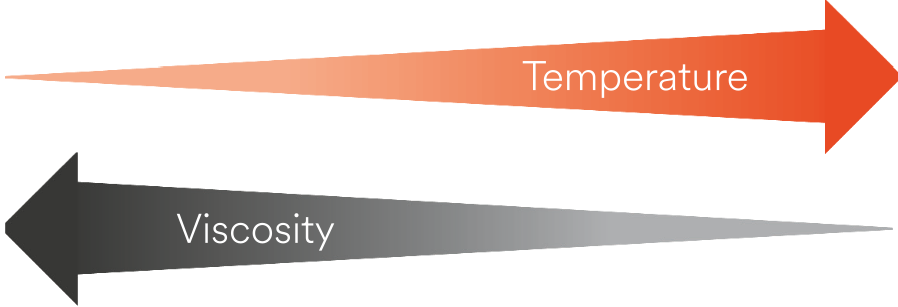
Rule of thumb for basecoats: For every 1 °C increase in temperature, viscosity decreases by approximately 1 s.

Temperature effect on viscosity
Figure 7: Increased temperatures lead to decreased viscosity

To remove impurities, dust, coarse metal particles, or dried paint residues from the coating bath, the coating must be filtered at intervals appropriate to the throughput. Recommended filter sizes can be found in the technical data sheets.

Comments (1)

  • Christian: Sollte die Liefergebinde wieder verwendet werden, kann durch Drehen der Spannringe (180Grad) ein leichterer Verschluss ermöglicht werden. - on May 1, 2025, 3:02 p.m.

Do you have constructive feedback?

Please log in to leave a comment.